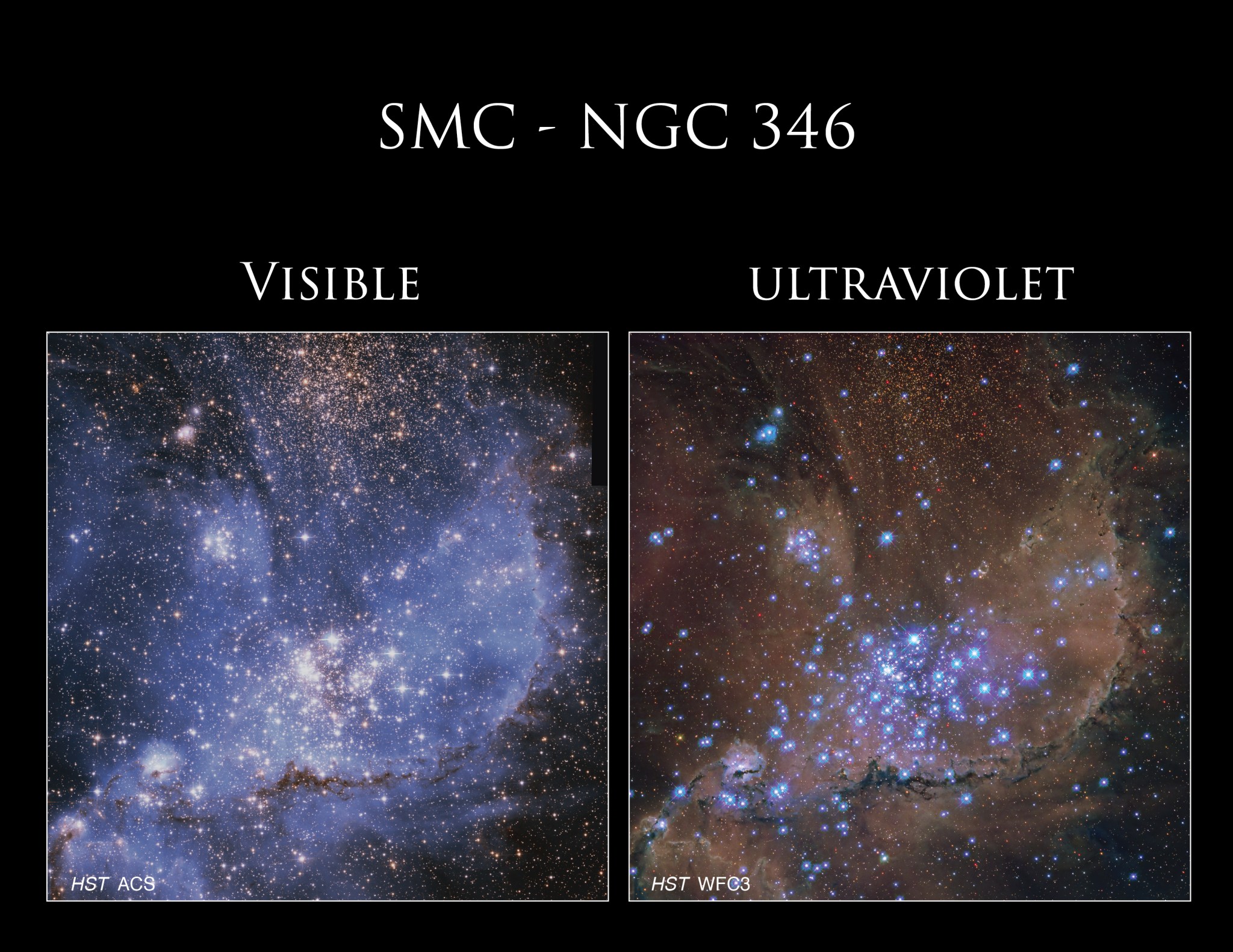
Image Source: link
The authors wanted to understand how FUV light from stars reacts with the gas and dust in galaxies and how this controls star formation. Their aim was to develop a mathematical model that could predict the intensity of FUV light based on the physical properties of galaxies (such as dust, gas density, and star formation rate). They also wanted to see how the effect of FUV differs from our Milky Way in galaxies with less smoke and heavy elements (dwarf or old galaxies).
In short: How strong is the Far-Ultraviolet (FUV) light within a galaxy (like the Milky Way), and what factors does it depend on?
The large and hot stars (massive stars) in space emit a very powerful light called Far-UV (FUV). We cannot see this light, but it is essential for heating the gas inside the galaxy and bringing about chemical changes in it.
There are two types of gas in the galaxy, one is cold gas, from which new stars are formed and the other is warm gas.
This (FUV) is a type of light which is more energetic (powerful) than the normal visible light. This light emanates from very hot stars (OB stars), heats the gas and can break the gas molecules. In simple words, the light emanating from OB stars (FUV light) heats the gas present in the galaxy, if the gas becomes too hot, then the cold gas will reduce. And star formation will decrease. But in this case, the entire galaxy will act like a heater system.
Now the question is, how strong is FUV? Or what factors does FUV intensity depend on?
According to this paper:
- Dust-to-Gas Ratio: Dust in the galaxy absorbs light. If there is more dust, FUV will absorb light, preventing it from reaching as far. And If there is less dust, light will travel further, causing more heat in the galaxy.
- Gas Density: If the gas is very dense, more light will be absorbed.
- Star Formation Rate (SFR): If more stars are forming, more OB stars will also form, producing more FUV light. This will heat up the gas and reduce cold gas, slowing the star formation rate.
- Galaxy Size: If the galaxy's disk is large: more stars can be present, resulting in a higher total light contribution.
Now, the overall conclusion is that if there is more dust, light will be trapped, which will lead to more cold gas, leading to a higher star formation rate.
If there is less dust, light will not be trapped and will be able to travel farther. This means that light will be able to heat up a lot of gas and dust, leading to a lower star formation rate. Dust not only traps light but also protects dust molecules (H₂). This suggests that dust is crucial for SFR.
The author of this paper, Shmuel Bialy, has developed a new "formula" (analytical model) that predicts the brightness of FUVs in any galaxy. He explains two main things:
- Dust effect (τ (tau)): This determines how much dust blocks light. Or rather, it tells us how much light the dust blocks at a distance between two stars.
- Galaxy size effect (X): This tells you how far apart the stars are. Or rather, it's the ratio of the galaxy's size to the distance between the stars.
Through derivation, they have given a simple formula which matches complex computer simulations to within 10%. The biggest result was that low-metallicity galaxies (such as dwarf galaxies or galaxies of the early universe) have very little dust. Dust normally absorbs FUV light, but when there is less dust, FUV radiation can travel farther and heat more gas. Therefore, for every unit of star formation, the FUV intensity in these galaxies can be 3–6 times higher than in the Milky Way. This means that the role of FUV heating in keeping the gas warm becomes very strong. When the gas heats up, less cold gas is formed, and star formation is naturally controlled. In this situation, it is possible that in some low-metallicity galaxies, FUV heating may play a more important role in regulating star formation than supernova explosions.
The behavior of FUV light within a galaxy depends primarily on the amount of dust. If the galaxy is heavily dusty, as in the Milky Way, FUV light is quickly absorbed and cannot travel far. In this situation, only the effect of nearby massive stars (OB stars) is significant, because the light from distant stars is absorbed in the dust. This is called the strong dust absorption regime, where FUV intensity is limited and heating occurs mostly locally.
On the other hand, if the galaxy is sparsely dusty, as in low-metallicity or dwarf galaxies, FUV light travels freely. In this case, not only nearby stars but stars from the entire galaxy contribute together, which can increase the total FUV intensity by 3–6 times compared to the Milky Way. This situation is called the weak dust absorption regime, where light is spread globally and can have a stronger effect on star formation.
“Strong dust absorption regime” does not refer to any specific place or region, but to a physical condition where the dust in the galaxy is so dense that FUV light cannot travel far. In this situation, light is quickly absorbed and only the effect of nearby massive stars (OB stars) remains significant, because the radiation of distant stars gets destroyed in the dust. This term describes the behavior of the system, where dust is strongly blocking the light, so heating is limited to a local level.
Feature More Dust Less Dust
- Light travel Short distance Long distance
- What contributes? Only nearby stars Whole galaxy
- FUV intensity Limited May be 3–6x higher
- Galaxy type Milky Way Dwarf / Early Universe
This research helps scientists understand how the speed of new star formation and the temperature of a galaxy change due to changes in dust and gas.
Source: https://arxiv.org/abs/2008.00009